pet behavior
 Why Dogs Kick the Ground After Pooping
 Your Older Pet May Not Be Lazy—Pain Can Look Like Slowing Down
 How pet cameras help owners spot problems they might otherwise miss
 How to Prepare Your Pet for a New Baby Before the Baby Arrives
 What “whale eye” means when your dog shows the whites of its eyes
 What Your Cat’s Tail Position May Be Saying
 Why dogs yawn even when they are not tired
 What a Rabbit “Binky” Says About Its Mood
 Why cats purr when they do not seem obviously happy
 How Pets May React When a Work-From-Home Owner Returns to the Office

Why Cats Quiver Their Tails When They Greet You
An upright tail that trembles when your cat approaches can be a sign of excitement and friendly social behavior. But because cats also quiver their tails while urine marking, the rest of the body—and the setting—matters. If your cat walks toward you with their tail standing almost straight up and suddenly makes it tremble like a tiny antenna, there is a good chance you are seeing an e.. ดูเพิ่ม

Is It Jealousy or Resource Competition Between Pets?
Dogs can show behaviors that resemble jealousy, but competition over food, toys, resting places, territory, and access to people can look remarkably similar. Watching what triggers the behavior is often more useful than trying to name the emotion. A dog wedges itself between you and another pet. A cat suddenly occupies your lap whenever its housemate approaches. One animal stares, vocalizes, bloc.. ดูเพิ่ม

Why Dogs Kick the Ground After Pooping
That burst of backward scratching is probably not an attempt to bury the evidence. Research suggests dogs use ground scratching as part of a scent-marking system that can leave both chemical and visible signals for other dogs. A dog finishes pooping, takes a step forward, then suddenly starts scraping the ground with its back feet and launching grass or dirt into the air. It may look like an enth.. ดูเพิ่ม

When a Cute Pet Costume Becomes a Stressor
Some dogs tolerate costumes and a few may genuinely enjoy the attention, but clothing can restrict movement, interfere with normal behavior or make an animal uncomfortable. Cats in particular may respond by hiding, struggling or simply freezing — a reaction that can be easy to misread. A dog dressed as a tiny superhero or a cat wearing a festive hat can make an irresistible photo. But the a.. ดูเพิ่ม

Why separate feeding stations can reduce tension between pets
Sharing a home does not mean pets need to share a dining area. Giving each animal its own feeding space can reduce competition, make meals calmer, and help caregivers monitor individual eating habits more accurately. A pair of pets can appear perfectly comfortable together until dinner arrives. Food is a valuable resource, and placing bowls too close together can create pressure that ranges from .. ดูเพิ่ม

What a Dog’s Play Bow Really Communicates
That familiar front-down, rear-up posture is one of the clearest signals in canine social play. Research suggests dogs use it not only to invite interaction, but also to restart play and keep a partner engaged. A dog drops its front legs toward the ground, keeps its hindquarters raised, and looks ready to spring in almost any direction. Most dog owners recognize the posture immediately: the play .. ดูเพิ่ม

How Pets May React When a Work-From-Home Owner Returns to the Office
Dogs and cats can become accustomed to having their owners home throughout the day. A sudden return to long workday absences may change their behavior, but gradual preparation can make the new routine easier to handle. For a pet that has spent months—or even years—with someone working a few feet away, a return to the office can change much more than the location of a laptop. Meals may.. ดูเพิ่ม

What flattened ears can mean in cats
A cat pressing its ears sideways or backward is usually communicating heightened arousal or discomfort, but the exact meaning depends on the rest of its body language. In some situations, changes in ear position may also appear alongside pain. A cat suddenly flattening its ears can look dramatic, but the signal does not translate neatly into a single emotion. Flattened or rotated ears often appea.. ดูเพิ่ม

Why a Reliable Recall Must Be Practiced in Stages
Coming when called is not a skill dogs learn once and automatically use everywhere. Reliable recall develops by gradually adding distance, distractions, and new environments while keeping practice rewarding and safe. A dog that races toward you every time you call from across the living room may seem to have mastered recall. Move the same dog into a park filled with smells, people, wildlife, and .. ดูเพิ่ม
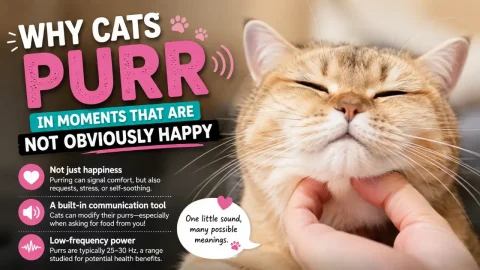
Why cats purr when they do not seem obviously happy
Purring is strongly associated with comfort, but research shows that cats can also use it as a flexible communication signal. The surrounding situation, body language, and individual cat matter more than the sound alone. A softly purring cat curled up on a warm lap looks like an easy behavior to interpret: the cat is happy. Often, that probably is exactly what is happening. But purring is not a o.. ดูเพิ่ม

How toddlers can learn to respect pet body language
Toddlers cannot be expected to interpret every flick of an ear or movement of a tail. But adults can teach a few simple rules that help young children recognize when a dog or cat needs space—and make daily interactions safer for everyone. A toddler does not need to become an expert in animal behavior to start respecting a pet’s boundaries. At this age, the most useful lesson is much s.. ดูเพิ่ม

What a Rabbit “Binky” Says About Its Mood
When a rabbit suddenly leaps, kicks and twists in midair, it is usually displaying one of its clearest signs of positive emotion. But a binky makes more sense when you read it alongside posture, activity and the rabbit’s usual behavior. A rabbit can be quietly nibbling hay one moment and airborne the next, twisting its body before landing as though it has just invented its own dance move. T.. ดูเพิ่ม

Why dogs yawn even when they are not tired
Dogs certainly yawn when they are sleepy, but researchers also observe yawning during stressful, emotionally arousing and social situations. The surrounding context often matters more than the yawn itself. A dog stretching out on the couch and letting out a huge yawn probably looks ready for a nap. But dogs also yawn while standing in a veterinary clinic, during training, around unfamiliar situat.. ดูเพิ่ม

Why decompression matters after a pet leaves a shelter
Moving from a shelter into a home can replace one stressful environment with a completely unfamiliar one. A calm space, predictable routine and gradual introductions can give newly adopted dogs and cats time to adjust without being overwhelmed. Leaving an animal shelter is a positive change, but a newly adopted pet may not understand that yet. A dog or cat arriving home suddenly faces unfamiliar .. ดูเพิ่ม

Why Cats Trill and Chirp at Their People
Those short, rolling sounds are often part of friendly social communication, especially during greetings or around something a cat wants. But the same noise does not carry one universal message, so the situation and the cat’s body language matter. A cat that spots its favorite person may answer with something much smaller than a meow: a quick chirp, a rolling “brrrp,” or a soft .. ดูเพิ่ม

What an Adopted Pet May Need During the First 72 Hours
A new home can be exciting for you and overwhelming for an adopted dog or cat. During the first three days, a quiet retreat, predictable routines, familiar food, and space to approach you voluntarily can matter more than constant attention. Bringing home an adopted pet can feel like the beginning of an instant friendship. For the animal, however, those first hours may feel more like arriving in a.. ดูเพิ่ม

How to Learn Your Pet’s Normal So Changes Stand Out
Your pet’s appetite, drinking, bathroom habits, activity, sleep, movement, and social behavior create a personal baseline. Paying attention to that pattern can make unusual changes easier to recognize and describe to a veterinarian. A dog that suddenly leaves breakfast untouched or a cat that stops jumping onto a favorite chair may be telling you something important. The challenge is recogn.. ดูเพิ่ม

How to Introduce a Cat and Dog Without Forcing Contact
A successful cat-and-dog introduction does not begin with a nose-to-nose meeting. Giving both animals space, escape routes, and time to become familiar with each other's scent can make the process calmer and safer. Bringing a cat and dog into the same home does not mean they need to meet immediately. In fact, animal-welfare guidance favors the opposite approach: keep early interactions controlled.. ดูเพิ่ม

What Your Cat’s Tail Position May Be Saying
A raised tail can signal a friendly approach, while puffing, tucking, or forceful swishing may point to tension or discomfort. But a cat’s tail makes the most sense when you read it alongside the rest of the body. A cat’s tail can offer useful clues about how the animal is feeling, but it is not a simple emotional code. A tail held high, tucked low, puffed out, or moving rapidly can m.. ดูเพิ่ม

What “whale eye” means when your dog shows the whites of its eyes
“Whale eye” describes the crescent of white that becomes visible when a dog turns its head or gaze while keeping track of something nearby. It often appears when a dog is uncomfortable, anxious, defensive, or trying to create space—but context matters. Your dog turns its head away but keeps watching you from the corner of its eye. Suddenly, a bright crescent of white appears aro.. ดูเพิ่ม