dog body language

What a Dog’s Play Bow Really Communicates
That familiar front-down, rear-up posture is one of the clearest signals in canine social play. Research suggests dogs use it not only to invite interaction, but also to restart play and keep a partner engaged. A dog drops its front legs toward the ground, keeps its hindquarters raised, and looks ready to spring in almost any direction. Most dog owners recognize the posture immediately: the play .. ดูเพิ่ม
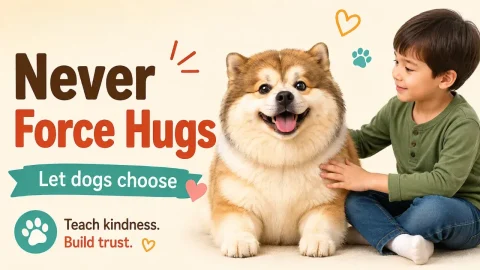
Why Children Should Never Be Asked to Hug an Unwilling Dog
A hug may look affectionate to a person while feeling restrictive to a dog. Teaching children to recognize canine body language—and allowing dogs to move away—can make everyday interactions safer and more comfortable for both. A child wrapping both arms around a beloved dog can look like a picture of friendship. From the dog’s perspective, however, that same embrace may restrict.. ดูเพิ่ม
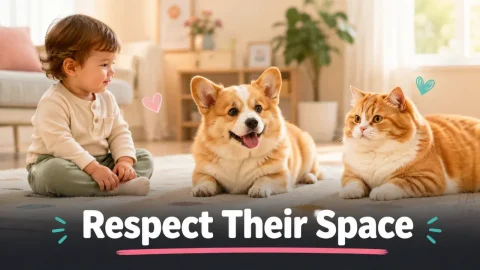
How toddlers can learn to respect pet body language
Toddlers cannot be expected to interpret every flick of an ear or movement of a tail. But adults can teach a few simple rules that help young children recognize when a dog or cat needs space—and make daily interactions safer for everyone. A toddler does not need to become an expert in animal behavior to start respecting a pet’s boundaries. At this age, the most useful lesson is much s.. ดูเพิ่ม

Why dogs yawn even when they are not tired
Dogs certainly yawn when they are sleepy, but researchers also observe yawning during stressful, emotionally arousing and social situations. The surrounding context often matters more than the yawn itself. A dog stretching out on the couch and letting out a huge yawn probably looks ready for a nap. But dogs also yawn while standing in a veterinary clinic, during training, around unfamiliar situat.. ดูเพิ่ม
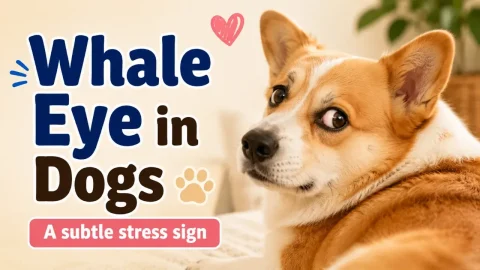
What “whale eye” means when your dog shows the whites of its eyes
“Whale eye” describes the crescent of white that becomes visible when a dog turns its head or gaze while keeping track of something nearby. It often appears when a dog is uncomfortable, anxious, defensive, or trying to create space—but context matters. Your dog turns its head away but keeps watching you from the corner of its eye. Suddenly, a bright crescent of white appears aro.. ดูเพิ่ม

Why Dogs Press Against Your Legs—and What Their Body Language Says
A dog leaning against your legs may be seeking affection, security, warmth, or attention. The surrounding situation and the rest of the dog’s body provide the clearest clues. When a dog presses its side, shoulder, or entire body against your legs, the simplest explanation is often that it wants to be close to you. But leaning is not a single-purpose signal: the same behavior can appear duri.. ดูเพิ่ม

Why Dogs Seem Jealous When You Pet Another Dog
A dog that wedges between you and another pet may be protecting access to something valuable: your attention. Research supports jealousy-like behavior in dogs, but the full explanation is more nuanced. Your hand reaches down to pet another dog, and suddenly your own dog appears between you. They may paw at your leg, nudge your hand, bark, whine, or try to push the newcomer away. It certainly look.. ดูเพิ่ม

Why Dogs Sleep by the Front Door—and When It Matters
The front door may offer a cool floor, a familiar routine, and the best view of household activity. Context—not the sleeping spot alone—reveals what your dog may be communicating. A dog stretched across the front door can look like a devoted guard waiting to protect the household. Sometimes the explanation is much simpler: that particular patch of floor may be cool, quiet, familiar, a.. ดูเพิ่ม
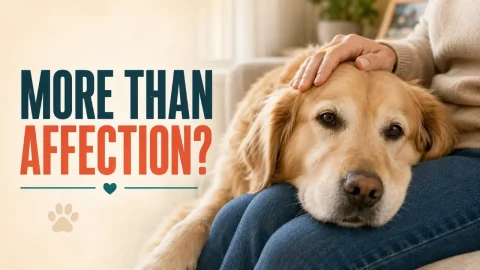
Why Dogs Put Their Head on Your Lap—and What They May Be Asking For
A dog’s heavy head on your lap may express affection, request attention, or seek reassurance. The rest of the body helps reveal what the gesture means in that moment. Your dog walks over, looks up at you, and gently places their head on your lap. It feels unmistakably affectionate—and often it is. But dogs do not use this gesture as a single sentence with one fixed translation. Depend.. ดูเพิ่ม

Why Dogs Stare at You While You Eat
That fixed stare across the dinner table is usually not random. Dogs often learn that human meals are full of clues, attention, and sometimes rewards. Your dog is not staring at your dinner by accident. That quiet, focused look from beside the table usually means your dog has learned that mealtime is one of the most interesting moments of the day. Sometimes the reason is simple: food smells good... ดูเพิ่ม

Why Dogs Lean Against Their Owners — and What It Usually Means
A dog’s gentle lean can feel like a hug, but it is also a form of communication. The meaning depends on the moment, the dog’s body language, and what usually happens next. A dog leaning against you is rarely random. That warm weight on your leg may be affection, comfort-seeking, attention, insecurity, or simply a habit that has always worked. For many owners, it feels sweet and famili.. ดูเพิ่ม

Why Dogs Sleep Belly Up—and What It Really Means
A dog sleeping on their back may look silly, but the position can say something about comfort, body temperature, and how safe they feel at home. A dog sleeping belly up can look ridiculous in the best possible way: paws loose, belly exposed, sometimes with a face that suggests they have never known stress in their life. For many dogs, that upside-down pose is exactly what it appears to be: a sign.. ดูเพิ่ม

Why Dogs Tilt Their Heads When You Talk to Them
That sideways look is not just adorable. A dog’s head tilt may involve attention, hearing, vision, learned behavior, and in rare cases, a health concern. A dog’s head tilt can feel like a tiny conversation. You say a familiar word — “walk,” “treat,” “dinner,” or maybe just your dog’s name — and suddenly that face turns to one side .. ดูเพิ่ม